
Choosing a welding helmet should not be based solely on appearance or price. The type of work you carry out, exposure to heat, risk of impacts, and the number of hours of daily use are key factors when selecting the right model.
At Dacar, many professionals ask us about the real differences between the DC-1 and DC-2 welding helmets. Although both models share much of the brand’s design philosophy — comfort, protection, and durability — each one is designed to meet different needs.
In this article, we take an in-depth look at the features of both welding helmets to help you choose the option that best suits your way of working. We have also recorded a video where we clearly and practically explain the differences between the DC-1 and DC-2 welding helmets.
Two Welding Helmets Designed for Different Needs
Before going into detail, it is important to understand one key idea: when we talk about the DC-1 and DC-2, we are referring to the helmet shell, not the auto-darkening filter.
You could compare it to a car:
- The bodywork would be the welding helmet shell.
- The engine would be the auto-darkening filter.
Both the DC-1 and DC-2 can be fitted with different auto-darkening filters depending on the welder’s needs.
The main difference between them lies in the structure, level of robustness, thermal performance, and intended use.
DC-1 Welding Helmet: Lightweight Design as the Top Priority
The DC-1 welding helmet was designed with one clear objective: to provide welders with an extremely lightweight and comfortable helmet for long working hours.
And this makes perfect sense. A professional who wears a welding helmet for many hours a day needs to minimise neck fatigue and strain on the neck and upper back as much as possible.
The low weight of the DC-1 is one of its main strengths. In addition, the total weight may vary slightly depending on the auto-darkening filter installed. In general, the larger viewing area:
- Larger filter size
- Greater overall weight
Even so, the DC-1 philosophy remains the same: maximum lightweight comfort without compromising protection.
Full Facial Protection and Ergonomic Design
Despite its lightweight design, the DC-1 provides extensive facial coverage.
The helmet protects:
- Face
- Neck
- Ears
And this is far from a minor detail. Many welders suffer small burns caused by reflections, sparks, or radiant heat in areas such as the neck or ears.
The geometry of the DC-1 helps minimise this issue.

Flexibility and Adaptation to Any Head Shape
Another key advantage of the DC-1 is its flexibility.
Many welding helmets on the market are too rigid and do not adapt properly to every head shape. This can lead to:
- Pressure points
- Discomfort
- Poor fit and stability
- A feeling of discomfort
The DC-1, on the other hand, is designed to adapt to the user — not the other way around.
Thanks to the flexibility of the shell, the helmet follows the headgear adjustment more naturally and adapts better to different head sizes, improving both comfort and stability.
Lightweight, Flexible and Durable
Although the DC-1 features a thin and lightweight structure, it fully complies with industry safety standards.
The shell is made from a nylon and fiberglass composite, a combination that provides:
- Thermal resistance
- Durability
- Flexibility
- Protection for intensive use
This makes it possible to maintain an extremely low weight without compromising long-term durability.
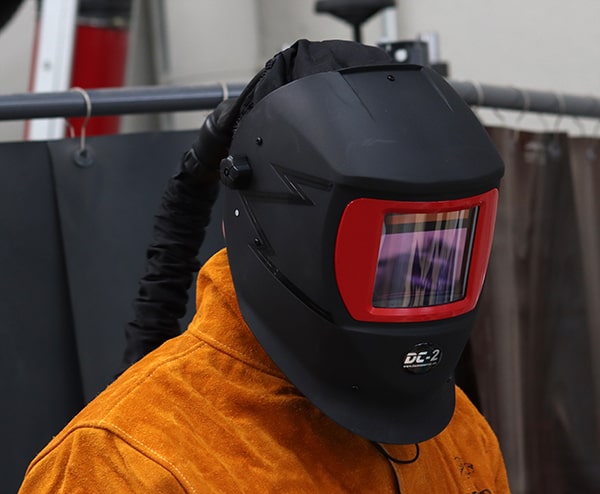
DC-2 Welding Helmet: Greater Robustness and Enhanced Thermal Protection
With the DC-2, Dacar pursued a different approach.
While the DC-1 prioritises the lowest possible weight, the DC-2 is designed for more demanding applications in terms of:
- Hot
- Impacts
- Intensive work
- Grinding and finishing operations
Visually, both helmets are similar, but the main difference lies in the front section and in the outer cover lens retention system.
The “sandwich-style” retention system
The main technical difference of the DC-2 lies in the mounting system of the outer cover lens.
How It Works on the DC-1 Welding Helmet
On the DC-1, the outer cover lens is slightly curved outward to:
- Improve fume deflection
- Reduce annoying reflections
- Maintain a clearer field of vision
In the event of a strong impact, the polycarbonate cover lens may flex towards the auto-darkening filter without compromising user safety.
How It Works on the DC-2 Welding Helmet
On the DC-2, the polycarbonate cover lens is supported on all four sides of the helmet and secured with a “sandwich-style” retention system.
This provides several advantages:
- Greater impact resistance
- Better sealing
- Greater thermal stability
- Better protection for the auto-darkening filter
In addition, the reinforced frame helps prevent deformation when the polycarbonate expands due to welding heat.
The result is a more robust structure designed for particularly demanding working environments.
Enhanced Protection Against Radiant Heat
The DC-2 shell is thicker than the DC-1 shell.
This allows it to provide:
- A better thermal barrier
- Greater insulation against radiant heat
- Greater comfort during high-amperage welding applications
For this reason, the DC-2 is especially recommended for applications where the welder works very close to the arc or at high amperages.
Is the DC-2 Welding Helmet Comfortable?
Yes. Although the DC-2 is more robust and slightly heavier, it still maintains a relatively low weight and excellent flexibility.
Dacar has successfully balanced:
- Protection
- Robustness
- Ergonomics
- Comfort
Without turning the helmet into a heavy or uncomfortable model.
A Headgear System Designed for Long Working Hours
Both the DC-1 and DC-2 feature the same headgear system.
This includes:
- WRD (Weight Redistribution Device)
- PRD (Pressure Reduction Device)
What Does the WRD Provide?
The WRD helps distribute the helmet’s weight across a larger support area and shifts part of the load towards the back of the head.
This significantly reduces the feeling of weight during use.

What Does the PRD Provide?
The PRD allows the helmet to be securely fitted without applying excessive pressure to the head.
In practice, this means:
- Less pressure
- Less fatigue
- Greater comfort throughout the working day
In addition, the headgear includes a padded sweatband with Velcro fastening to further improve comfort.
Shared Features of the DC-1 and DC-2 Welding Helmets
Both models share several important features:
Excellent facial coverage
Both helmets provide extended protection for:
- Face
- Neck
- Ears
Curved front covers
The curved design helps to:
- Improve fume deflection
- Reduced reflections
- Better visibility
Floating auto-darkening filter system
Auto-darkening filters incorporate relatively delicate LCD screens.
To protect them, Dacar has designed a floating spring-mounted retention system that:
- Keeps the filter securely in place
- Absorbs torsion and impacts
- Reduces the risk of damage
This significantly increases the overall durability of the system.
So… Which Model Should You Choose?
The DC-1 is ideal if you are looking for:
- The lowest possible weight
- Maximum comfort
- TIG welding applications
- Low-amperage welding applications
- Lower thermal exposure
- Lower risk of impacts
The DC-2 is the best option if you work with:
- Con altos amperajes
- Close to the welding arc
- High-heat working environments
- Grinding or finishing operations
- Applications with a high risk of impacts


